“Cold Mountain is an extraordinary novel about a soldier’s perilous journey back to his beloved at the end of the Civil War. At once a magnificent love story and a harrowing account of one man’s long walk home…”
That’s from a review of the 1997 book that was made into a popular movie with Nicole Kidman and Jude Law in the lead roles. That’s not the Cold Mountain Bill and I experienced.
 It’s understood that the aforementioned novel is a work of historical fiction, a story told with accurate period details of people who were not real in a place that was real. Still is. The real Cold Mountain is a 6,000-foot peak in the Appalachians of western North Carolina. Today, many a hiker takes it on and, I can now tell you from experience, ascending Cold Mountain makes for a long walk, no matter the distance.
What drew us there, originally, was a planned outing by the Chattanooga Hiking Club. We are now dues-paying members, and the group has a website with a schedule of group hikes for the next three months or so. Small numbers of mostly retired members go on short, local hikes around Chattanooga two or three times a week. Saturday and weekend excursions are more ambitious, both in travel to reach them and in trail difficulty.
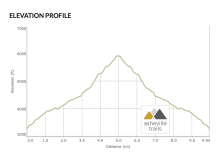
Cold Mountain on Saturday, July 13 had been on the calendar for weeks. I’ll admit when I first saw it, I didn’t actually know it was a real place—I’d just assumed it was also a fictional setting for the book. I was intrigued by the idea of experiencing the real place, and it promised to give your money’s worth for effort. Ten miles round trip, with a 3,000-foot elevation gain. Almost exactly the same as hiking Alum Cave trail to Mount LeConte in the Smokies—which I’ve done at least 20 times over the years—so I figured I was capable.
I spoke with the Chattanooga Hiking Club member who was to lead the Cold Mountain hike, booked a room in the hotel where the group was staying and looked forward to the new adventure. Then, about two weeks earlier, word was sent that Cold Mountain was off for the time being. A group outing to do a section of the Benton-MacKaye trail had experienced such brutal heat combined with trail difficulty that the decision was made not to attempt Cold Mountain in July, but to put it off until cooler weather.
Naturally, I wanted to press ahead, so Bill and I kept our hotel reservations and our plans to visit Waynesville, NC and Cold Mountain over July 12-13.
Out of a very healthy respect for a daunting elevation gain and challenging trail, I began working on challenging hikes closer to home—see “Kicked by the North Chick” posted here earlier—and I took inventory of what we had and what we might need to hike Cold Mountain. A trip to REI resulted in some new water sandals and a synthetic, tech-fabric pair of shorts and a shirt for Bill; and an amazing waterproof plastic holder for my phone that would allow the phone to function even inside the plastic and with a neck cord to keep it from getting lost.
Just as the hiking club had intended, we went to dinner in Waynesville at the Sweet Onion. We allowed ourselves to carb load, munched on small, pre-meal biscuits; Bill had mashed potatoes with his salmon; and I had rice noodles with Thai peanut sauce and what unfortunately turned out to be unchewable sliced chicken breast.
We found a Mast General Store just around the corner from the restaurant, and I bought a brand-new, waterproof, rip-proof trail map showing Cold Mountain in the Pisgah National Forest.

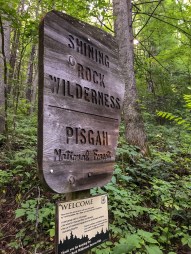
 Also just as the hiking club had intended, we had breakfast—and a few more carbs—at the hotel Saturday morning. Fifteen miles later, we were at the Art Loeb trailhead to Cold Mountain in the Shining Rock Wilderness area of North Carolina. The temperature was comfortable, birdsong echoed all over the woods, and sounds of kids having fun rose up from the adjacent Boy Scout Camp Daniel Boone. “Good job, North Carolina,” I thought, “paying homage to a legendary Tennessean.”
Don’t come at me about Daniel Boone being born in Pennsylvania. He got out of there, didn’t he?
But I digress…
About 9 a.m., we shoved off, and about 9:04 a.m., we were navigating the first switchbacks. When a trail starts with switchbacks, you know it’s going to be a serious climb. Which you would have expected from a 3,000’ start to a 6,000’ summit in about five miles.
 Swinging over blowdown: Nothin’ to it but to do it.
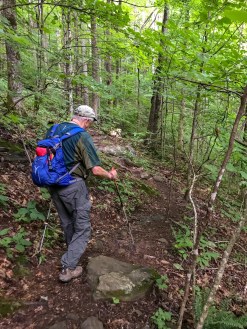 We were sweaty and had to stop to catch our breath at mile 1, which climbed 800 feet up and took us 59 minutes to complete.
Mile two leveled out considerably, gaining only 200 feet and taking us 28 minutes to complete.
Mile three angled up again, with a 400-foot climb and took me 31 minutes to complete. I say me because Bill clocked out around the 2.5-mile point. The humidity and steep stepping ended his run—though he’d never expected nor intended to go the whole way, and he’d done a great, big chunk of difficult.
We had begun encountering increasing piles of blow-down on the trail approaching the halfway point and, in general, the trail became rougher and more overgrown as it climbed.
I don’t do blow-down as athletically as Bill can.
I reached mile 4 in about 40 minutes, slowed down by climbing another 400 feet and stopping to put gaiters on over my boots because of the overgrown conditions and sprinkling rain that had begun. Of course, Mother Nature also had begun clearing her throat—rolling out some impressive thunder—by then, too.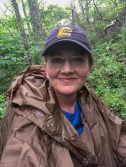
Mile 5 was back down to a one-hour pace, owing to a 550-foot elevation gain and the start of an actual thunderstorm. I was hiking through heavy forest canopy, which kept the rain off for some time, and I’d gotten into my heavy-duty poncho before the real rain reached me. Not that it mattered. I was so hot and sweaty when I put on the poncho I don’t know how much wetter I could have felt if the rain had drenched me.
First, this hike was described as 10 miles, round-trip, five up, five down. Yet, while FitBit showed I had traveled five miles, there was sign of the summit. So, I’ve got to check the stride length FitBit is showing for me and tinker to get it more accurate.
Second, I was getting pretty hungry and the plan of holding out to eat when I got to the summit was seeming less likely. Not to mention it was well past noon and, distance aside, I knew I still had about 800 more feet of climb, regardless. That takes a lot out of you, and Bill was again waiting for my return back at the car.
I decided to press on for a little longer, until FitBit told me I was at six miles. If I wasn’t at the summit by then, I didn’t plan to continue.
At 2 p.m., I hit the FitBit-measured six-mile mark. The skies were pouring. Thunder was rumbling in every direction. I hadn’t eaten since breakfast and was getting very hungry. A nice log aside the trail practically said, “Sit here, eat your lunch, watch if the rain stops, then see what time it is.”
It was practically 2:30 p.m., I had something like six miles to do if I turned back right where I was and, even if I reached the summit in just another 30 minutes—not likely with another 500 feet of elevation to climb, according to my altitude gizmo—chances were good of being able to see nothing except the raincloud I’d be standing in.
Yes, we had come for the weekend for the purpose of ascending Cold Mountain. Yes, it was hard as #$%& just reaching the point where I sat. And believe it or not, I’ve never yet ended up in a bind on a hike that I saw coming. Continuing to climb in foul weather at 2:30 p.m. and leaving my husband, with no means of communication, waiting at the trailhead well into dark wasn’t necessary and easily avoidable this time.
Besides, I just might try again with the hiking club, and I left myself the best part still to see.
I made pretty good time descending, though with everything wet or rain-slick, there was a bit of treachery here and there.

Here I have to say that rumors of all young people falling short of one’s own generation are greatly exaggerated. Even at my best pace, which wasn’t bad at averaging 20-minute miles in those conditions, I was overtaken by a group of about five 20-something boys. For a long way they were behind me where the trail was a single-file only tunnel of rhododendron.
I waited for a wider spot where I could step aside and let them pass. When it came, every one of them greeted me or said “Thank you,” and the last of the bunch said, “Ma’am, would you like someone to hike with you?” I told him I was just fine and to head on.
After an hour or so, another male hiker who also appeared to be in his 20s caught up with me. I stepped aside at the first opportunity, and he made polite conversation about the rude weather, thanked me, then asked if I would like for him to stay back with me. No, no, I told him I was fine. Though I’ve never felt so old as having two separate young hikers offer to escort me—I must be slower and older-looking than I realize. As the solo young hiker with what could have been a mini-fridge on his back almost as big as he was moved easily and disappeared quickly around a turn, I also felt old.

By 5:30 p.m., I was back at our SUV, it was no longer raining and the sun was out. Nice ending a long hike before dark. Bill was pleasantly surprised, too, and really surprised when I told him I’d made the decision to turn back.
He told me I must have been motoring down the mountain. I didn’t understand and asked what made him say that.
“This group of five young guys just finished here about 5 o’clock, and I asked if they had seen my wife who was hiking solo,” Bill said. “ ‘Oh, yes sir, she was heading down the mountain at a good pace when we caught up with her. She’s probably about 30 minutes behind us.’ And they were right on the money. Here you are.”
Finally, about the relationship between Cold Mountain the place and Cold Mountain the book. The author, Charles Frazier, reportedly based the novel on local history and family stories passed down by his great-great-grandfather. The story is about a wounded Confederate soldier who walks away from the war and back home to his sweetheart. I’ve seen the movie and read the book specifically in anticipation of the hike, hoping for the possibility of interesting detail about the setting.
Truth be told, there was a lot of detail, and much of it bleak, heavy and, after a while, repetitious. As someone who’s logged hundreds of miles through the Appalachians, I recognized and could picture most every type of scenery, forestation, plant and weather Frazier described. But by the end of the book, I’d had enough of grim gore and devastating disease.
So, let me say that, even though I didn’t make it to my destination on Cold Mountain, it was a wonderful experience that has washed the dark taste of the book from my mouth.
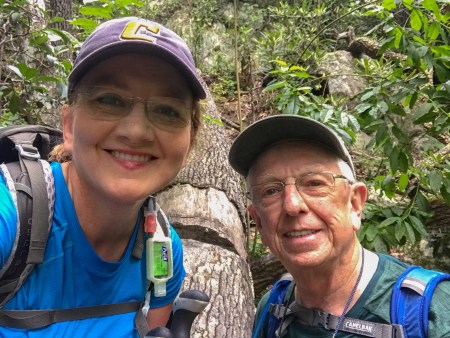
Given the chance to be part of a group outing, I’ll go back.


 wordsandpictures.blog
Leave a reply to Gina Stafford Cancel reply